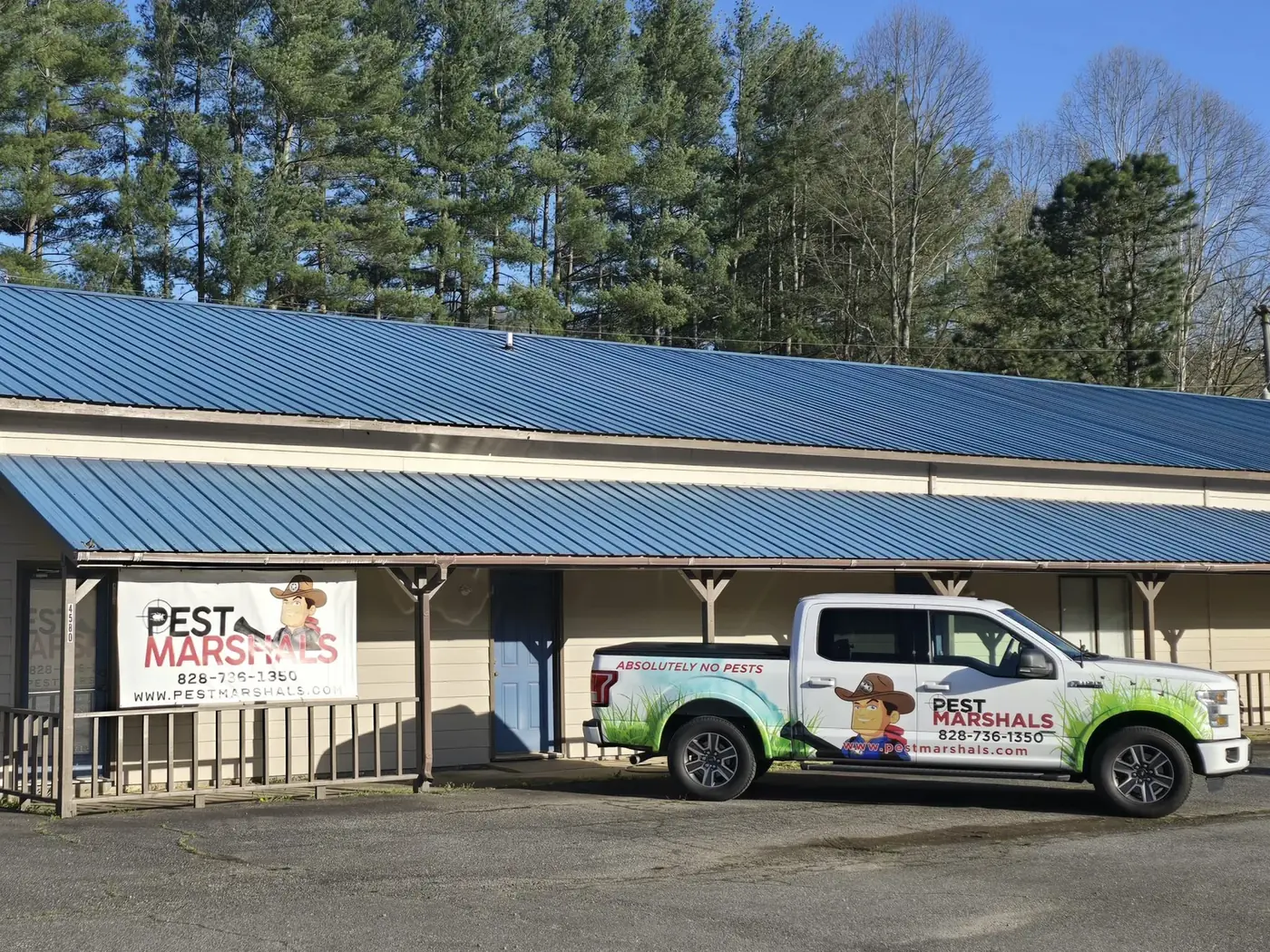

What we do
We identify the species first, then knock down the nest, treat the hiding spots, and clean up the comb so nothing reuses the spot. Eaves, soffits, decks, ground burrows, sheds, attic vents, hollow railings.
Active nest? We'll handle it. Pest Marshals removes paper wasp, yellow jacket, bald-faced hornet, and European hornet nests at homes across Western NC. Honey bees get relocated, never killed. Free quote, 24/7. Marshal's Shield guarantee.
We identify the species first, then knock down the nest, treat the hiding spots, and clean up the comb so nothing reuses the spot. Eaves, soffits, decks, ground burrows, sheds, attic vents, hollow railings.

Every nest is different. Dusty walks the property, identifies the species, and gives you a free, written quote on the spot. Most jobs get scheduled the same week. No upfront fee.

Once you approve the quote, we remove the nest and treat the spot it was built on so the next colony does not move in. Every job is backed by the Marshal's Shield. New nest in the same spot? We come back free.
Western NC sits inside the natural range of every common stinging wasp on the East Coast. Paper wasps, yellow jackets, bald-faced hornets, and the introduced European hornet all build nests here, and our climate gives them a long, productive season from May through October. Per the NC State Extension yellow jacket guide, a single mature ground colony can hold thousands of workers by August.
The good news: most of these nests are easy to deal with safely if you know which species you're looking at and you treat at the right time of day. The bad news: a yellow jacket ground burrow or a bald-faced hornet football nest under the eave is not a job for a hardware-store can. That's where Pest Marshals comes in. Identify the species, pick the right method, knock it down, and treat the spot so it stops being attractive.
All five are common in the Asheville area, and each one calls for a different approach. We identify the species first, then pick the method that handles it without anyone getting stung.
Open umbrella-shaped nests under eaves, porch ceilings, deck railings, mailbox doors, grill covers. Usually 10 to 50 wasps. Defensive, not aggressive — most stings happen when someone walks straight into one. Quick to remove.
Build ground burrows in old rodent holes, mulch beds, retaining wall gaps, hollow logs. Also build aerial nests in attic vents and soffit cavities. Highly aggressive in late summer when the colony peaks. Per the NC State Extension yellow jacket guide, a mature WNC colony can hold thousands of workers by August.
Big gray football-shaped paper nests hanging from tree branches, eaves, or attached to siding. Black and white striped, larger than a yellow jacket, very defensive of the nest. Mature nests can hold 400-700 workers. Removed at night when the colony is calm.

The largest hornet in NC, brown and yellow, often confused with a giant yellow jacket. Active at night, nests inside hollow trees, wall voids, attic spaces, and shed cavities. Bangs against lit windows after dark. Treated at the void where the colony lives, not at the entry.

Long, thin, solitary wasps that build mud tubes on porches, sheds, and stone walls. Almost never sting. Removed because the abandoned tubes get reused by more aggressive species and mar the look of trim, siding, and outdoor furniture.
The big shiny black-and-yellow bees that drill perfect dime-sized holes in cedar trim, decks, fascia boards, porch posts. Females do the drilling, males hover and look intimidating but cannot sting. We treat the holes and seal them so woodpeckers don't tear out the rest of the board chasing the larvae.
Honey bees are different. Pest Marshals does not kill honey bees. If we identify a true honey bee colony in your wall or attic, we refer you to a local beekeeper for live relocation. Read the honey bee policy below for the why.
A paper wasp nest under the eave and a bald-faced hornet football in a tree are two different jobs. Same with a yellow jacket ground burrow. We pick the method based on the species and the location.
Paper wasp nests are open-comb and visible. Once we identify them as paper wasps and not yellow jackets, we treat with a residual product, wait for the workers to settle, knock the nest down, and remove the comb so nothing reuses the spot. Usually a 30 minute call.
Yellow jacket ground burrows, bald-faced hornet football nests, and European hornet wall voids are aggressive and dangerous to treat in daylight. We come back at dusk or after dark when the colony has returned and is quiet, treat the nest at the entry, and remove it the next day. Per the NC State Extension yellow jacket guide, this is the safest method for a mature colony.

Honey bees pollinate roughly a third of the food in this country. NC is a top-five honey-producing state and runs a state-funded apiculturist program through the NC Department of Agriculture. If we get to a job and find a true honey bee colony, we stop, identify it, and refer you to a local beekeeper for live relocation.
Most "bees in the wall" calls actually turn out to be yellow jackets or hornets. We can tell which is which from a five-minute look. If you are unsure what's in your wall or attic, call (828) 736-1350 and we will identify it before any treatment.
Hardware-store hornet sprays work fine on a single paper wasp on the porch. Used on a yellow jacket ground burrow or a bald-faced hornet football, they tend to make things worse. The spray agitates the colony, the colony defends, and someone goes to the ER for a hundred stings. NC State Extension flags this exact failure mode.
The product hits the entry, the workers feel the impact, and a few hundred of them come out at once. The 20-foot range on the can does not match the response radius of a mature ground colony. People get chased into the house.
Most ER visits from DIY wasp removal are not stings. They are falls. Spraying a nest under the eave from a ladder, getting hit by one wasp, flinching off the ladder. Dusty has a 24-foot ladder, a bee suit, and a safe ladder hand on every job.
The visible nest is the workers and the comb. The queen lives deeper in. Treating only the visible nest leaves the queen, and the colony rebuilds in the same wall void within a week. A real removal treats the void, not just the entry.
Active aggressive nests get bumped to the front of the line. Same workflow either way.

Dusty walks the property, locates the nest, identifies the species, and explains the plan. No charge, no pressure, written quote at the visit. If it turns out to be a honey bee colony, you get a beekeeper referral.
Paper wasps and mud daubers in the daytime, yellow jackets and hornets at dusk or after dark. Bee suit, ladder, residual treatment to the comb and the void. Every nest comes down before we leave so nothing flies back to it.

If a new colony shows up in the same spot before the season ends, we come back free. The Marshal's Shield covers every removal. Quarterly general pest service is available if you want preventative coverage on the entire exterior.
Every Pest Marshals wasp and hornet removal is backed by the Marshal’s Shield. New colony in the same eave, same ground burrow, same wall void? Call (828) 736-1350 and we come back free. Not satisfied? Your money back.

Seventeen years in NC pest control. The video on the left is Dusty applying a perimeter at an Asheville property. Same person walks the property at the inspection, identifies the species, picks the method, and shows up at dusk if it's a hornet job. No call center, no subcontractor, no rotating tech.
Pest Marshals of Asheville and WNC is owner-operated, NC licensed, and fully insured. The bee suit Dusty wears for hornet removals is not a prop. He uses it on his own property when he gets a yellow jacket burrow in the yard.
If a customer's kid gets stung after we removed a nest, that's on me. So I treat every nest like it's at my house.
Wasp and hornet removal across the seven counties below. Tap your town to start a free quote.
Not on the list? Call anyway. We cover more of Western NC than this map shows.
Call 828-736-1350Fill out the form or call (828) 736-1350. Dusty calls back personally, identifies the species, and hands you a written scope and free estimate before any work begins.
Answer a few quick questions. Dusty calls back the same day.
No contract. No spam. Your info only goes to Dusty.